
The Stress Hormone That's Quietly Reshaping Your Body
What chronic stress is doing to your metabolism in midlife

“My diet isn’t perfect, but I’ve really been trying.”
The majority of the women I work with come to me feeling like they’re putting in a fair amount of effort. They don’t understand why even after going to the gym Monday to Friday, denying themselves of their favourite foods, and waiting to eat until noon their waistlines continue to grow.
What you're experiencing is not a failure of discipline. Ironically, it could be that you’re doing too much.
Because here's what most conventional health advice leaves out: in midlife, chronic stress — including the stress of over-exercising, under-eating, and pushing through exhaustion — keeps a hormone called cortisol chronically elevated. And elevated cortisol drives blood sugar dysregulation, insulin resistance, and the accumulation of belly fat.
Once you understand the mechanism, the experience stops feeling personal and starts feeling manageable.
Let me explain.
Cortisol: The Hormone Running the Show
When your brain perceives a threat (e.g. a difficult conversation, a looming deadline, or a flood of morning notifications) it sends a signal to your adrenal glands to release cortisol.
Cortisol gets a bad rap, but it’s actually an essential hormone designed to help you survive. In an acute stress response, cortisol raises your blood sugar to give your muscles emergency fuel, temporarily suppresses digestion and immune function, and sharpens your focus. Once the threat passes, cortisol drops, blood sugar returns to baseline, and your body returns to its normal operations.
That's the design.
The problem is that most midlife women are not living in short, acute bursts of stress. They are living with chronic, low-grade stress that never fully resolves, which means cortisol stays elevated in ways the body was never built to sustain.
What Chronically Elevated Cortisol Does to Your Blood Sugar
Every time cortisol rises, it signals the liver to release stored glucose into the bloodstream. This is the body flooding the system with fuel in anticipation of physical exertion that, in modern life, rarely comes.
The result is persistently elevated blood sugar as a result of the stress (even without the cookie you had to deal with that stress).
Your pancreas, doing its job, responds by producing insulin to bring that blood sugar back down. Insulin acts like a key, unlocking your cells so they can absorb glucose for energy. In a healthy, low-stress system, this works beautifully.
But when cortisol keeps triggering blood sugar spikes day after day, your cells begin to lose sensitivity to insulin's signal. They've heard it so many times, at such high volumes, that they start tuning it out. This is what happens with insulin resistance, and it is one of the most common, most underdiagnosed conditions in midlife women.
When your cells become insulin resistant, glucose can't get in. It stays in the bloodstream. Your pancreas produces even more insulin to compensate, and that excess insulin has to do something with all that circulating glucose. Solution? It converts it to fat.
Specifically, to visceral fat.
Why It Goes Straight to Your Belly
Visceral fat is the fat stored deep inside the abdominal cavity, packed around your organs. Unlike subcutaneous fat (the kind you can pinch), visceral fat is metabolically active. Much like a separate gland, it produces its own hormones and inflammatory compounds that further disrupt your metabolism.
Here's the part that makes visceral fat particularly stubborn in midlife: cortisol receptors are concentrated in abdominal fat tissue. This means that your body, under chronic cortisol exposure, is essentially programmed to store stress as belly fat.
And then it gets more complicated.
Visceral fat itself produces a hormone called cortisol locally, creating a feedback loop where stress creates belly fat that creates more cortisol that creates more belly fat. It is not a lack of effort that keeps this cycle going. It is biology.
Why Midlife Makes Everything Worse
For most of a woman's reproductive years, estrogen acts as a quiet, powerful buffer in this system. It improves insulin sensitivity, helps regulate cortisol's effects on fat storage, and tends to direct fat toward the hips and thighs rather than the abdomen.
As estrogen declines in perimenopause and postmenopause, that buffer disappears.
Suddenly the same level of stress that your body handled reasonably well in your thirties hits differently. Insulin sensitivity drops. Cortisol's effects on fat storage become more pronounced. And because the HPA axis (the stress response system) also becomes less regulated as estrogen declines, cortisol itself can run higher and longer than it used to.
This is why midlife weight gain — particularly abdominal weight gain — often appears even when nothing about your diet or lifestyle has changed. The system has fundamentally shifted. You're not doing anything wrong. You're playing by the old rules in a new metabolic reality.
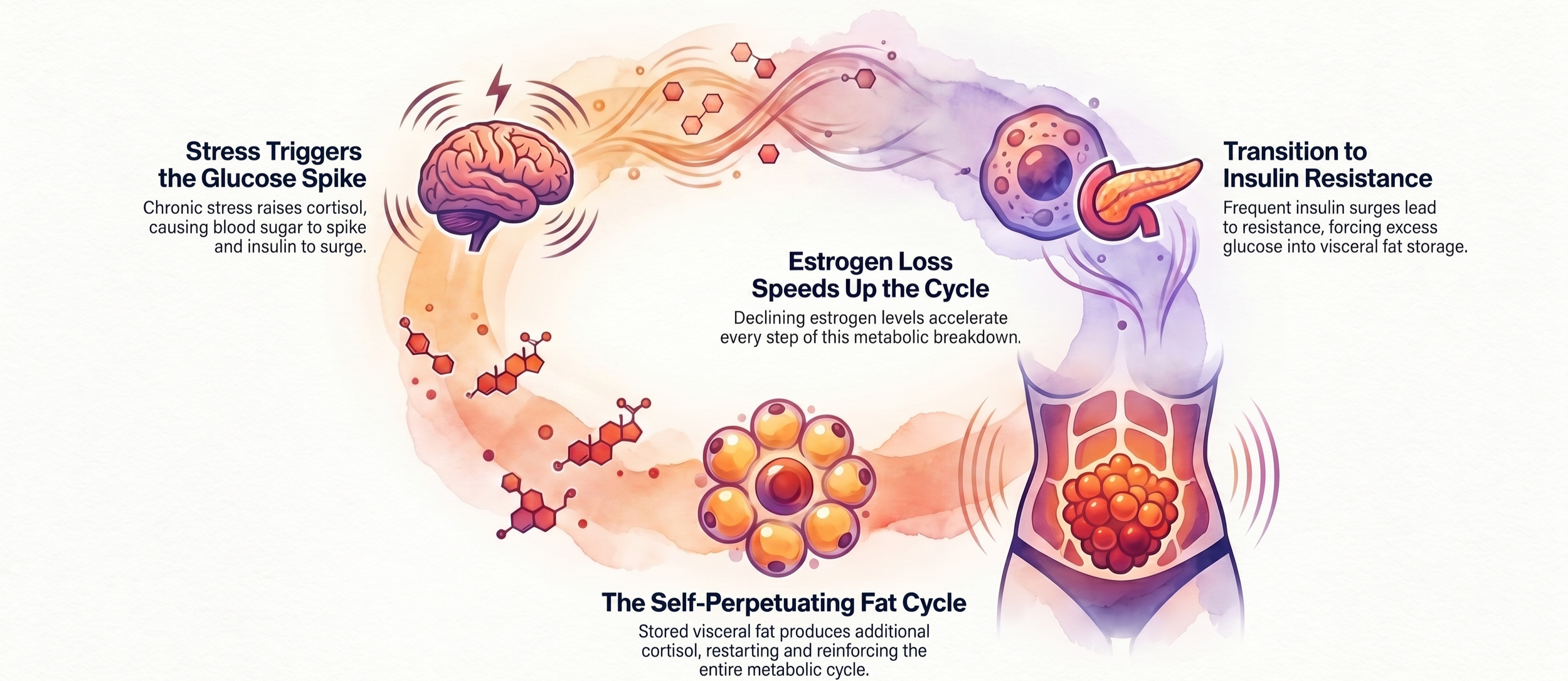
Chronic stress → elevated cortisol → blood sugar spikes → insulin surges → insulin resistance → excess glucose stored as visceral fat → visceral fat produces more cortisol → repeat.
Declining estrogen accelerates every step.
Breaking the cycle doesn't start with eating less or exercising harder. It starts with the cortisol, because that is where the whole cascade begins.
What Actually Helps
Prioritize blood sugar stability at meals. Eating protein and healthy fat before or alongside carbohydrates slows the glucose response and reduces the insulin spike that follows. This doesn't mean eliminating carbohydrates — it means pairing them thoughtfully.
Move after eating. Even a ten-minute walk after a meal meaningfully improves glucose uptake in the muscles, reducing how much ends up circulating (and eventually stored). This is one of the highest-impact, lowest-effort blood sugar tools available.
Treat sleep as a metabolic intervention. Poor sleep raises cortisol, impairs insulin sensitivity, and increases cravings for high-sugar foods — all by the next morning. Protecting sleep quality is not optional if blood sugar regulation is the goal.
Address the cortisol directly. Nervous system regulation is a direct intervention in the cortisol-blood sugar-visceral fat cycle. Every time you bring your nervous system out of sympathetic activation, you are lowering the signal that starts the whole cascade.
Reduce inflammatory foods. Ultra-processed foods, refined sugars, and seed oils amplify the inflammatory output of visceral fat, worsening insulin resistance. This is not about perfection, but about what you are habitually putting in your body most days.
A Final Word
The conversation around midlife belly fat has been dominated by shame, willpower, and caloric arithmetic for too long. What it actually requires is an understanding of stress physiology, hormonal context, and the specific ways a woman's metabolism changes in the second half of life.
Your belly is not the problem. Chronic stress meeting a changing hormonal landscape is the problem.
This is exactly what we address inside the Whole Belly Reset. If you're ready to understand your body on its own terms and build a sustainable path back to metabolic balance, I'd love to connect. Learn more here.
